2012 学術論文アーカイブ Japanese Shiatsu Academic Archive
前頚部指圧による呼吸商(RER)の変動
Variation in Respiratory Quotient Induced by Anterior Cervical Shiatsu
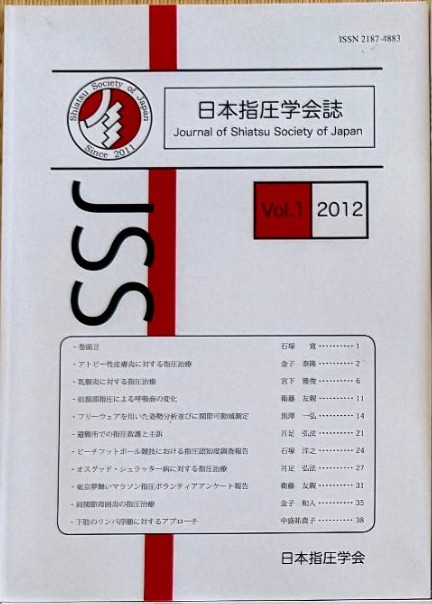
『日本指圧学会誌』Vol.1, pp.11-13, 2012
1書誌情報 Bibliographic Information
- 論文名Title
- 前頚部指圧による呼吸商(RER)の変動Variation in Respiratory Quotient Induced by Anterior Cervical Shiatsu
- 著者Authors
- 衛藤 友親、桑森 真介Tomochika Etou, Masasuke Kuwamori
- 所属Affiliation
- 明治大学体力トレーナー/明治大学商学部教授
- 発表年Year
- 2012
- 掲載Published in
- 『日本指圧学会誌』Vol.1, pp.11-13, 2012Journal of Shiatsu Society of Japan, Vol. 1, pp. 11–13, 2012
- 所蔵・収録Archive
- 株式会社日本指圧研究所 所蔵『日本指圧学会誌』Vol.1(2012)
2要旨 Abstract
浪越式基本指圧において、全身施術の起点として最も重視される「前頚部指圧(胸鎖乳突筋内縁の総頚動脈拍動部から鎖骨上窩への4点圧)」が全身代謝に及ぼす影響を検証。呼気ガス分析装置を用いて、指圧刺激群(健常成人12名)と無刺激対照群(8名)における呼吸商(呼吸交換比:RER)の推移を計測・比較した。分散分析および多重比較の結果、指圧群において指圧開始45秒後・60秒後に有意な呼吸商の低下(P<0.05, P<0.01)が確認された。
This experimental study investigated the systemic metabolic effects of anterior cervical Shiatsu—a fundamental procedure in the Namikoshi Shiatsu method applied along the carotid triangle. Using an expired gas analysis system, the respiratory exchange ratio (RER) was monitored in a Shiatsu group (n=12) and a resting control group (n=8). Repeated-measures ANOVA and post-hoc analyses revealed a statistically significant decrease in RER at 45 seconds (P<0.05) and 60 seconds (P<0.01) after the initiation of Shiatsu stimulation, while the control group showed no significant change.
3臨床的解説 Clinical Commentary
4引用・出典 Citation & Source
学術出典Academic Reference
衛藤 友親, 桑森 真介: 前頚部指圧による呼吸商(RER)の変動. 日本指圧学会誌, 1: 11–13, 2012.
宮下雅俊の解説と見解|株式会社日本指圧研究所Commentary by Masatoshi Miyashita | Japan Shiatsu Institute
臨床において伝統的に「全身治療の導入」として用いられてきた頚部操作が、単なるリラクゼーションにとどまらず、呼気代謝や自律神経系(迷走神経反射等)に即時的かつ客観的な変化をもたらすことを示した貴重な原著論文です。徒手による局所的な刺激が全身の生理動態に与える影響を科学的に裏付けるものであり、施術の手順・配分に確固たる理論的根拠(Rationale)を与えるものです。
In clinical Shiatsu, anterior neck application is traditionally positioned as the initial step for whole-body treatment. This study provides empirical physiological evidence that targeted manual pressure over the anterior cervical region rapidly modulates respiratory metabolism and autonomic pathways. It reinforces the scientific foundation of Japanese manual therapy, offering global manual therapists a clear rationale for the systemic impact of cervical touch.