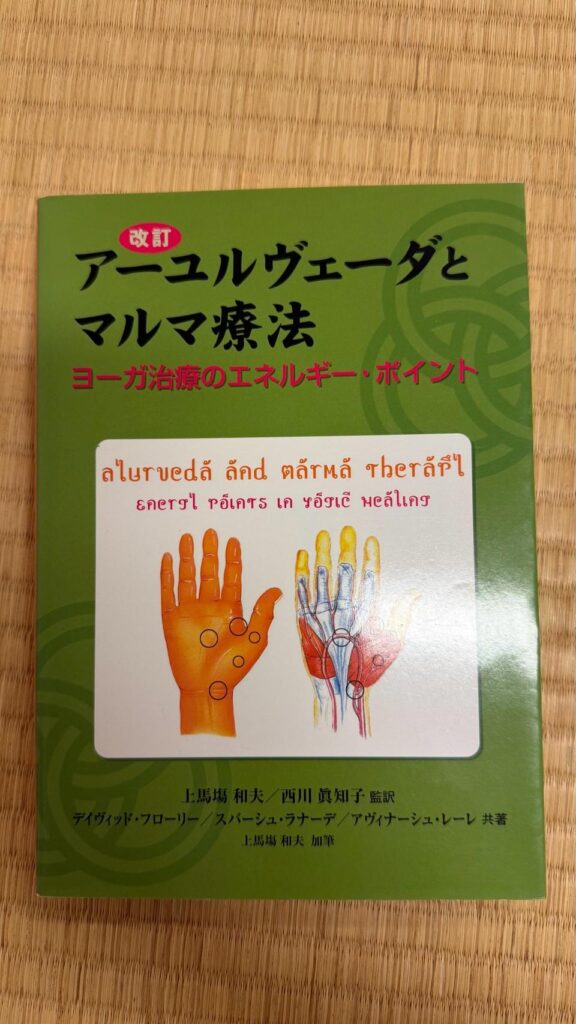
表紙(所蔵本)|株式会社日本指圧研究所Cover (copy held by the Institute) | Japan Shiatsu Institute
棚3 No.1 古書紹介 Classics of Shiatsu 世界の手技療法Manual Therapies of the World
アーユルヴェーダとマルマ療法
Ayurveda and Marma Therapy
インドの伝統医学アーユルヴェーダにおける「マルマ」107の主要ポイントについて、位置・特性・用法を体系的に示した、日本語で読める本格的なマルマ療法の書。
A full-scale work on marma therapy that systematically presents the location, characteristics and use of the 107 principal marma points of Ayurveda, the traditional medicine of India.
1書誌情報 Bibliographic Information
- 書名Title
- アーユルヴェーダとマルマ療法Ayurveda and Marma Therapy
- 著者Author(s)
- デイヴィッド・フローリー/スバーシュ・ラナーデ/アヴィナーシュ・レーレ 共著David Frawley, Subhash Ranade & Avinash Lele
- 出版社Publisher
- 株式会社ガイアブックス(東京都港区赤坂1-1-16)Gaia Books (1-1-16 Akasaka, Minato-ku, Tokyo)
- 発行年Year
- 2009年2009
- 版・刷Edition
- 2009年3月20日発行/所蔵本は第2刷(2015年5月1日)Published 20 March 2009 / Institute’s copy: 2nd printing, 1 May 2015
- 奥付の記載Colophon
- 書名 改訂 アーユルヴェーダとマルマ療法 ―ヨーガ治療のエネルギー・ポイント
監訳 上馬場和夫/西川眞知子(上馬場和夫 加筆)
翻訳 大田直子
定価 本体2,800円+税
ISBN 978-4-88282-697-2
原書 Ayurveda and Marma Therapy(Lotus Press)Japanese title: Kaitei Āyuruvēda to Maruma Ryōhō — Yōga Chiryō no Enerugī Pointo (Revised Ayurveda and Marma Therapy: Energy Points in Yogic Healing)
Supervising translators: Kazuo Uebaba and Machiko Nishikawa (with additions by Kazuo Uebaba)
Translator: Naoko Ota
Price: 2,800 yen + tax
ISBN 978-4-88282-697-2
Original: Ayurveda and Marma Therapy (Lotus Press) - 構成Structure
- 第1部 マルマ概論/第2部 マルマとその療法/第3部 追加資料および補遺Part 1: Introduction to the Marmas / Part 2: The Marmas and Their Therapy / Part 3: Additional Material and Appendices
- 所蔵Collection
- 株式会社日本指圧研究所Japan Shiatsu Institute Co., Ltd.
3総目次 Contents
監訳者のことば(上馬場和夫)/はしがき(アトレヤ・スミス)/著者からの序文
第1部 マルマ概論 ―ヨーガとアーユルヴェーダのエネルギー・ポイント
- 第1章 マルマ ―ヨーガとアーユルヴェーダのエネルギー・ポイント(アーユルヴェーダ医学とマルマ療法/マルマとヨーガ体系/マルマとヴェーダ科学/マルマ、タントラ、シッダ医学/マルマの歴史的背景/マルマと武術)
- 第2章 アーユルヴェーダ治療の体系とマルマ療法(3つのドーシャ/マルマとアーユルヴェーダの体質/7つの組織(ダートゥ)/老廃物(マラ)/導管経(スロータス)/消化力(アグニ))
- 第3章 マルマの特性と分類
- 第4章 マルマとヨーガ行法(マルマと7つのチャクラ/マルマと14本のナーディ/マルマとアーサナ行法/マルマとプラティヤーハーラとプラーナーヤーマ/マルマ瞑想/マルマとマントラ/マルマと色彩や宝石の療法 ほか)
- 第5章 マルマ療法の手法(1)―マッサージ・アロマ療法・プラーナ療法(マルマ・マッサージとオイル・マッサージ/アロマ療法/マルダナ(指圧)/プラーナ療法、エネルギー療法)
- 第6章 マルマ療法の手法(2)―ハーブ療法
第2部 マルマとその療法
- 第7章 マルマ図とマルマ療法の概要
- 第8章 腕と手のマルマ(11のマルマ領域と22のポイント)
- 第9章 脚と足のマルマ(11の領域と22のポイント)
- 第10章 腹と胸のマルマ(8の領域と12のポイント)
- 第11章 背中と腰のマルマ(7の領域と14のポイント)
- 第12章 頭と首のマルマ(14の領域と37のポイント)
第3部 追加資料および補遺
- 補遺1 マルマ療法における器具の使用 ―瀉血・鍼・アグニカルマ・クシャーラカルマ
- 補遺2 マルマ鍼灸(アーユルヴェーダ式鍼灸治療)
- 補遺3 アーユルヴェーダと中国医学の類似理論(上馬場和夫 執筆)
- 補遺4 マルマの名称と分類/補遺5 サンスクリット語のアーユルヴェーダ用語/補遺6 アーユルヴェーダのハーブとオイル/補遺7 関連情報
Words from the Supervising Translator (Kazuo Uebaba) / Foreword (Atreya Smith) / Preface by the Authors
Part 1: Introduction to the Marmas — Energy Points of Yoga and Ayurveda
- Chapter 1: Marmas — Energy Points of Yoga and Ayurveda (Ayurvedic medicine and marma therapy / Marmas and the yogic system / Marmas and Vedic science / Marmas, Tantra and Siddha medicine / Historical background of the marmas / Marmas and the martial arts)
- Chapter 2: The System of Ayurvedic Treatment and Marma Therapy (The three doshas / Marmas and Ayurvedic constitution / The seven tissues (dhātus) / Waste products (malas) / Channels (srotas) / Digestive fire (agni))
- Chapter 3: Characteristics and Classification of the Marmas
- Chapter 4: Marmas and Yogic Practice (Marmas and the seven chakras / Marmas and the fourteen nāḍīs / Marmas and āsana practice / Marmas, pratyāhāra and prāṇāyāma / Marma meditation / Marmas and mantra / Marmas and colour and gem therapy, etc.)
- Chapter 5: Methods of Marma Therapy (1) — Massage, Aromatherapy and Prana Therapy (Marma massage and oil massage / Aromatherapy / Mardana (shiatsu) / Prana therapy and energy therapy)
- Chapter 6: Methods of Marma Therapy (2) — Herbal Therapy
Part 2: The Marmas and Their Therapy
- Chapter 7: Marma Charts and an Overview of Marma Therapy
- Chapter 8: Marmas of the Arms and Hands (11 marma regions and 22 points)
- Chapter 9: Marmas of the Legs and Feet (11 regions and 22 points)
- Chapter 10: Marmas of the Abdomen and Chest (8 regions and 12 points)
- Chapter 11: Marmas of the Back and Hips (7 regions and 14 points)
- Chapter 12: Marmas of the Head and Neck (14 regions and 37 points)
Part 3: Additional Material and Appendices
- Appendix 1: The Use of Instruments in Marma Therapy — Bloodletting, Needles, Agnikarma and Kṣārakarma
- Appendix 2: Marma Acupuncture (Ayurvedic Acupuncture)
- Appendix 3: Parallel Theories in Ayurveda and Chinese Medicine (by Kazuo Uebaba)
- Appendix 4: Names and Classification of the Marmas / Appendix 5: Sanskrit Ayurvedic Terms / Appendix 6: Ayurvedic Herbs and Oils / Appendix 7: Resources
4本の特徴 Features of the Book
- インドの伝統医学アーユルヴェーダにおける「マルマ」(生命エネルギーが集まる急所・ポイント)107の主要ポイントについて、位置・特性・用法を体系的に示した、日本語で読める本格的なマルマ療法の書。
- マルマへの手法として、マッサージ、アロマ、ハーブと並んで「マルダナ(指圧)」が正規の手法として章を割いて解説されている。著者序文でも、本書の手法には「指圧や鍼灸、マッサージ」が含まれると明記されている。
- マルマはヨーガのチャクラやナーディ(エネルギーの通り道)とも結びつけられ、ヨーガとアーユルヴェーダを統合する鍵として位置づけられている。
- 監訳者の上馬場和夫による加筆と補遺(「アーユルヴェーダと中国医学の類似理論」)が加わり、中国医学のツボ(経穴)とマルマの異同を考える材料が日本語で読める。
- A full-scale work on marma therapy, available in Japanese, that systematically sets out the location, characteristics and use of the 107 principal “marma” points — the vital points where life energy gathers — in Ayurveda, the traditional medicine of India.
- Among the methods applied to the marmas, mardana (shiatsu) is treated as a regular method with its own chapter, alongside massage, aromatherapy and herbs. The authors’ preface also states plainly that the book’s methods include “shiatsu, acupuncture and moxibustion, and massage.”
- The marmas are linked with the chakras and nāḍīs (energy channels) of yoga, and are presented as the key to integrating yoga and Ayurveda.
- With additions and an appendix by the supervising translator Kazuo Uebaba (“Parallel Theories in Ayurveda and Chinese Medicine”), the book offers Japanese readers material for considering the similarities and differences between the acupuncture points of Chinese medicine and the marmas.
5要約 Summary
第1部では、マルマの概念と歴史的背景、アーユルヴェーダの体質論(ドーシャ)との関係、ヨーガ行法との関わり、そしてマッサージ・アロマ・指圧(マルダナ)・ハーブといった具体的な手法が概説される。第2部では、腕と手、脚と足、腹と胸、背中と腰、頭と首という部位ごとに、マルマの領域とポイントが図とともに示される。第3部の補遺では、マルマ鍼灸や、中国医学との類似理論などが補われる。
監訳者の上馬場和夫は「監訳者のことば」で、中国医学の代表的治療である鍼灸の作用を知るにはツボ(経穴)の概念の理解が必要であり、インドではそれが「マルマ」の考え方であると説く。さらに2008年の第30回日本アーユルヴェーダ学会におけるBinod Joshiの講演「中国鍼術の起源となったインドのマルマ療法について」を紹介し、ヴェーダ時代のインドでツボ概念がマルマ/シラー/ダマニーと呼ばれていたこと、24種類のダマニーは中国医学の24の経絡に他ならないという推定、そしてその知識がインドでは度重なる侵略により消え、中国の鍼灸の古典の中に残存してきたという見立てを示し
Part 1 outlines the concept and historical background of the marmas, their relation to Ayurvedic constitutional theory (the doshas), their connection with yogic practice, and concrete methods such as massage, aromatherapy, shiatsu (mardana) and herbs. Part 2 presents, region by region — arms and hands, legs and feet, abdomen and chest, back and hips, head and neck — the marma regions and points, together with charts. The appendices of Part 3 add material on marma acupuncture and on parallel theories in Chinese medicine.
In his “Words from the Supervising Translator,” Kazuo Uebaba explains that understanding the action of acupuncture and moxibustion, the representative treatments of Chinese medicine, requires an understanding of the concept of acupuncture points, and that in India this corresponds to the idea of the “marma.” He goes on to introduce Binod Joshi’s lecture at the 30th meeting of the Japanese Society of Ayurveda in 2008, “On Indian Marma Therapy as the Origin of Chinese Acupuncture,” setting out the view that in Vedic India the concept of acupuncture points was called marma, sirā and dhamanī; the conjecture that the 24 kinds of dhamanī are none other than the 24 meridians of Chinese medicine; and the view that this knowledge disappeared in India through repeated invasions but survived in the classics of Chinese acupuncture. Uebaba himself concludes by asking whether, by integrating traditional Chinese medicine and traditional Indian medicine with modern medicine in Japan, it might be possible to create a scientific and trustworthy integrative medicine.
The foreword by Atreya Smith notes that marma points may differ from person to person, so that the therapist needs a kind of sensitivity to find the regions where prana is concentrated, and that the revised edition of this book adds practical information “for Western massage and shiatsu therapists.”
書評|宮下雅俊 Review by Masatoshi Miyashita
この本は、私にとって衝撃的な一冊でした。
きっかけは、ヨーガの師であるグルジ(スワミ・クリシュナプラーナナンダ・サラスワティ)からヨーガを習っていた時のことです。マルマの話を聞いて「何ですか、それは」と尋ねると、中国にツボがあるように、インドにもマルマという、ツボと同じようなものがあるのだ、と。それがマルマ療法だと教わりました。今から4、5年前の話です。私は治療家の道に入って20年、その間、マルマ療法という言葉は一度も耳に入ってこなかった。そんなものがあるのか、とすぐにこの本を買いました。
驚きは二つありました。一つは、「断末魔」という言葉です。最後の叫びの声を意味するこの言葉が、マルマの語源から来ているというのです。
もう一つは、首の前です。浪越指圧の特徴の一つに、前頸部――首の前を押していく施術があります。私はこれを、他にはない独特の治療法だと聞いてきました。ところがマルマ療法の本を読むと、そこにも首へのアプローチがある。「あるじゃないか」と、自分の中で大きな驚きでした。調べてみると、オステオパシーでも首の前を触っていく方法はあるようです。ただ、それがいつからなのかは、よく分かりません。
浪越徳治郎先生が小田川義松先生からさまざまな技を習った、その時代の時点で、昔からインド経由でそうした治療法が日本に入っていたのではないか。私はそう考えています。私の師・平島利文先生も講義の中で、指圧は中国の推拿やインドのアーユルヴェーダから流れてきた技術かもしれないが、日本人に合うように継承してきたのが指圧だ、という話をされていました。この本は、その言葉を裏側から照らす一冊だと思います。
世界の手技療法の棚の最初にこの本を置くのは、そのためです。カイロプラクティックやオステオパシーに先立つ、はるかに古い「押す治療」の源流が、ここにあります。
For me, this book came as a shock.
It began while I was learning yoga from my yoga teacher, Guruji (Swami Krishnapranananda Saraswati). When he spoke of marma, I asked, “What is that?” He told me that just as China has acupuncture points, India too has something like them, called marma — and that this is marma therapy. That was four or five years ago. In the twenty years since I entered the path of a therapist, the words “marma therapy” had never once reached my ears. Is there really such a thing? I bought this book at once.
There were two surprises. The first was the word danmatsuma — the death cry, the last scream. This word, I learned, comes from the same root as marma.
The second was the front of the neck. One of the characteristic features of Namikoshi shiatsu is a treatment that presses along the anterior neck. I had always been told that this was a unique method found nowhere else. Yet reading this book on marma therapy, I found an approach to the neck there too. “So it does exist,” I thought — it was a great surprise to me. Looking into it further, it seems that osteopathy also has methods that work on the front of the neck. When that began, however, I do not really know.
I believe that by the time Tokujiro Namikoshi learned various techniques from Yoshimatsu Odagawa, such methods of treatment had long since come into Japan by way of India. My own teacher, Toshifumi Hirashima, also said in his lectures that shiatsu may be a technique that flowed from Chinese tuina or Indian Ayurveda, but that it is shiatsu which has carried it on in a form suited to the Japanese. I think this book sheds light on those words from the other side.
That is why I place this book first on the shelf of manual therapies of the world. Here lies the source of a “pressing treatment” far older than chiropractic or osteopathy.
(Composed from the oral account of Masatoshi Miyashita. English translation by the editor.)