1998 学術論文アーカイブ Japanese Shiatsu Academic Archive
指圧刺激による心循環系に及ぼす効果について
Effects of Shiatsu Stimulation on the Cardiovascular System(研究所訳)
社団法人東洋療法学校協会 学会誌 第22号, pp.40–45, 1998年
1書誌情報 Bibliographic Information
- 論文名Title
- 指圧刺激による心循環系に及ぼす効果についてEffects of Shiatsu Stimulation on the Cardiovascular System(研究所訳)
- 著者Authors
- 小谷田作夫、宮崎幸夫、川又吉宗、高橋慎哉、谷口雛子、齋藤明美、櫻井照美、春名秀孝、山本明子
(指導)小久保和夫、藤井正弘、浪越孝、浪越満都子、大沢秀雄(筑波技術短期大学)、森英俊(筑波技術短期大学)Sakuo Koyata, Yukio Miyazaki, Yoshimune Kawamata, Shinya Takahashi, Hinako Taniguchi, Akemi Saito, Terumi Sakurai, Hidetaka Haruna, Akiko Yamamoto
(Advisors) Kazuo Kokubo, Masahiro Fujii, Takashi Namikoshi, Matsuko Namikoshi, Hideo Ohsawa, Hidetoshi Mori - 所属Affiliation
- 日本指圧専門学校 指圧研究会
- 発表年Year
- 1998
- 掲載Published in
- 社団法人東洋療法学校協会 学会誌 第22号, pp.40–45, 1998年Journal of the Japan Association of Certified Care Facilities for Acupuncture, Moxibustion, and Massage, Vol. 22, pp. 40–45, 1998.
- 所蔵・収録Archive
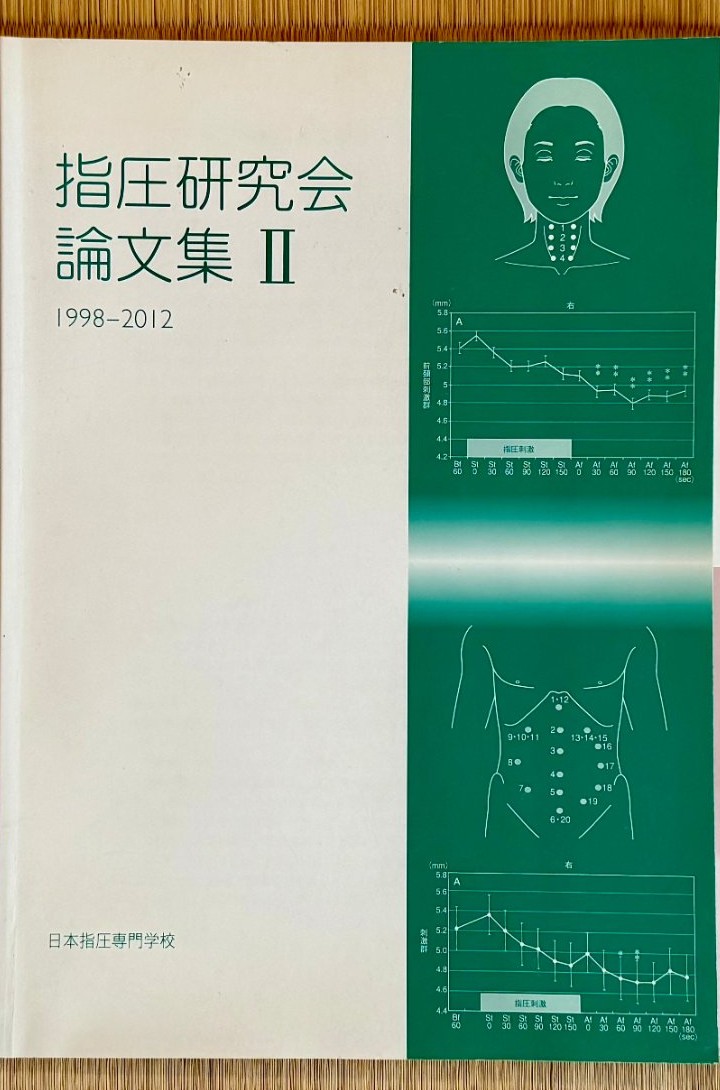
- 『指圧研究会論文集Ⅱ(1998〜2012)』pp.1–5(株式会社日本指圧研究所 所蔵)
2要旨 Abstract
本研究は、指圧刺激が生体の心循環系(心拍数および末梢血管容積)に及ぼす生理的影響を客観的に検討した、指圧研究会における基礎研究シリーズの第1報である。
日本では、指圧は法令に明記され、あん摩マッサージ指圧師の国家免許制度のもとに位置づけられている。一般的なマッサージの揉捏や摩擦とは異なり、指圧療法は生体に対して垂直に圧を加え、徐々に強め(漸増)、一定時間保ち(持続)、徐々に抜く(漸減)独自の「押圧法(おうあつほう / ouatsu-ho)」、および関節の可動性を整える「運動操作」を技術の根幹とする。
健康成人27名を対象に、下腿外側部、頭部正中線、腹部(小腸部)、前頚部への通常圧法(快圧5〜15kgによる漸増漸減押圧)、および腹部波状掌圧を実施し、ポリグラフシステムを用いて瞬時心拍数と指尖容積脈波を経時的に記録・解析した。その結果、通常圧法を行った4部位すべてにおいて刺激中に有意な心拍数減少(最大5.4%〜6.7%の減少)が認められた。一方、脈波は刺激開始直後に一過性の縮小を示した後に回復した。侵害的な痛み刺激が心拍数を増加させるのに対し、指圧の適正な押圧は心拍数を減少させることが実証され、体性-自律神経反射を介した循環器系の沈静作用が示された。
This study investigated the physiological effects of Shiatsu stimulation on the human cardiovascular system (heart rate and peripheral digital pulse waves), representing the foundational investigation of the 15-year research series conducted by the Shiatsu Research Group.
In Japan, Shiatsu is legally defined and practiced under the national licensing system for practitioners of Anma, Massage, and Shiatsu. Distinct from conventional massage techniques involving kneading (petrissage) or friction, Shiatsu is grounded in its core method termed ouatsu-ho (押圧法 / perpendicular pressure application)—applying pressure perpendicularly to the body surface, gradually increasing it (progressive), sustaining it (sustained), and gradually releasing it (regressive)—as well as joint mobilization maneuvers (運動操作 / undō-sōsa).
Twenty-seven healthy adults (12 males, 15 females) were evaluated during standard ouatsu (comfortable pressure of 5–15 kg) applied to the anterolateral lower leg, head midline, abdomen, and anterior neck, alongside abdominal wave-like palm pressure. Instantaneous heart rate and fingertip photoplethysmographic pulse waves were continuously recorded using a polygraph system. Standard ouatsu applied to all four body regions elicited statistically significant reductions in heart rate (peak reductions of 5.4% to 6.7%, p < 0.01 or p < 0.05). Fingertip pulse waves demonstrated a transient initial constriction at 10 seconds post-onset before rapidly recovering. Unlike nociceptive stimuli that trigger tachycardic responses, appropriate ouatsu induces heart rate deceleration, demonstrating autonomic cardiovascular sedation via somato-autonomic reflex pathways.
3結語と測定結果 Conclusions & Findings
原論文の結語
健康成人において、下腿外側、頭部正中線、腹部(小腸部)、前頚部への通常押圧法により心拍数が有意に減少し、刺激開始直後には各部位で指尖脈波の一過性縮小が生じることが確認された。
結語を支える測定結果
- 心拍数の有意な減少:通常圧法を用いた4部位(下腿外側1点目、頭部正中線、腹部小腸部、左前頚部1点目)すべてで、刺激開始10秒以降に有意な心拍数低下が確認された(p < 0.01 または p < 0.05)。
- 指尖脈波の一過性縮小:全刺激部位において、刺激開始10秒時点で脈波波高値の有意な縮小(16%〜24%)がみられ、その後速やかに前値に復帰した(p < 0.01 または p < 0.05)。
Summary of Conclusions
In healthy adults, standard ouatsu delivered to the lower leg, head midline, abdomen, and anterior neck significantly decreased heart rate during stimulation, accompanied by transient initial constriction of digital pulse waves.
Supporting Measurements
- Significant Reduction in Heart Rate: Standard ouatsu across four anatomical regions consistently produced statistically significant decreases in heart rate starting from 10 seconds into stimulation (p < 0.01 or p < 0.05).
- Transient Digital Pulse Wave Constriction: All stimulated regions demonstrated a transient 16%–24% reduction in pulse wave amplitude at 10 seconds following stimulation onset before returning to baseline (p < 0.01 or p < 0.05).
4臨床的解説 Clinical Commentary
5引用・出典 Citation & Source
学術出典Academic Reference
小谷田作夫, 宮崎幸夫, 川又吉宗, 他: 指圧刺激による心循環系に及ぼす効果について. 東洋療法学校協会学会誌, 22: 40-45, 1998.
臨床論文・症例報告での引用文例
小谷田ら(1998)は、健康成人27名を対象に各部位への指圧(押圧)刺激が心循環系に及ぼす影響を検討し、下腿、頭部、腹部、前頚部への通常圧法刺激中に有意な心拍数減少が全身的に生じることを報告している。
Citation Example for Clinical Studies
Koyata et al. (1998) evaluated cardiovascular responses to Shiatsu (ouatsu) in 27 healthy adults, demonstrating that standard perpendicular pressure applied to the lower leg, head, abdomen, and anterior neck systematically induced significant heart rate deceleration during stimulation.
宮下雅俊の解説と見解|株式会社日本指圧研究所Commentary by Masatoshi Miyashita | Japan Shiatsu Institute
臨床で患者様の体に触れるとき、私は呼吸や脈の落ち着き、手足の温まりといった全身の反応に常に注意を払っています。ここで用いる指圧の手技は、組織を強く揉みほぐすことではなく、体表に対して垂直に圧を浸透させ、一定時間保ち、静かに抜く「押圧(ouatsu)」です。
この1998年の論文が重要なのは、頭部、頚部、腹部、下肢という全く異なる分節への押圧であっても、痛みを伴わない快圧であれば、共通して心拍数が有意に減少するという事実を捉えた点にあります。これは、押圧が局所の刺激にとどまらず、自律神経系を介して全身の循環トーンを鎮静側へシフトさせる可能性を示しています。
石川太刀雄先生の内臓体壁反射の研究に照らすと、皮膚や筋への体性感覚入力が内臓諸器官に及ぼす影響の広がりがあらためて意識されます。刺激直後に手足の血管が一過性に収縮しつつ、心拍数が穏やかに低下していく生体反応は、臨床において患者様が「緊張から解放され、深く落ち着く」プロセスと重なります。腰痛や筋緊張を抱える方の背景にある自律神経の過緊張に対して、全身への押圧がどのような生理的意義を持つのかを考える確かな原点となる研究です。
When treating patients in clinical practice, I continuously monitor systemic signs of autonomic relaxation, including changes in respiration, pulse rhythm, and peripheral warmth. The manual intervention used here is not aggressive tissue kneading, but ouatsu (押圧)—gradually delivering focused perpendicular pressure into the tissues, holding it steadily, and smoothly releasing it.
The vital insight from this 1998 study is that comfortable ouatsu elicited significant heart rate deceleration across entirely distinct segments: the head, neck, abdomen, and lower limbs. This indicates that appropriate ouatsu does not merely exert localized mechanical action, but activates systemic neuro-autonomic mechanisms that shift cardiovascular balance toward rest.
Viewed through the lens of Dr. Tachio Ishikawa’s work on viscerosomatic and somatovisceral reflexes, somatic input to the body wall clearly exerts extensive regulatory effects on internal organ dynamics. The physiological sequence of transient peripheral vascular constriction followed by heart rate deceleration mirrors the clinical process wherein a patient transitions out of sympathetic hyperarousal into deep relaxation. This study serves as an empirical cornerstone for understanding how full-body ouatsu addresses underlying autonomic tension in patients presenting with musculoskeletal stiffness and chronic pain.