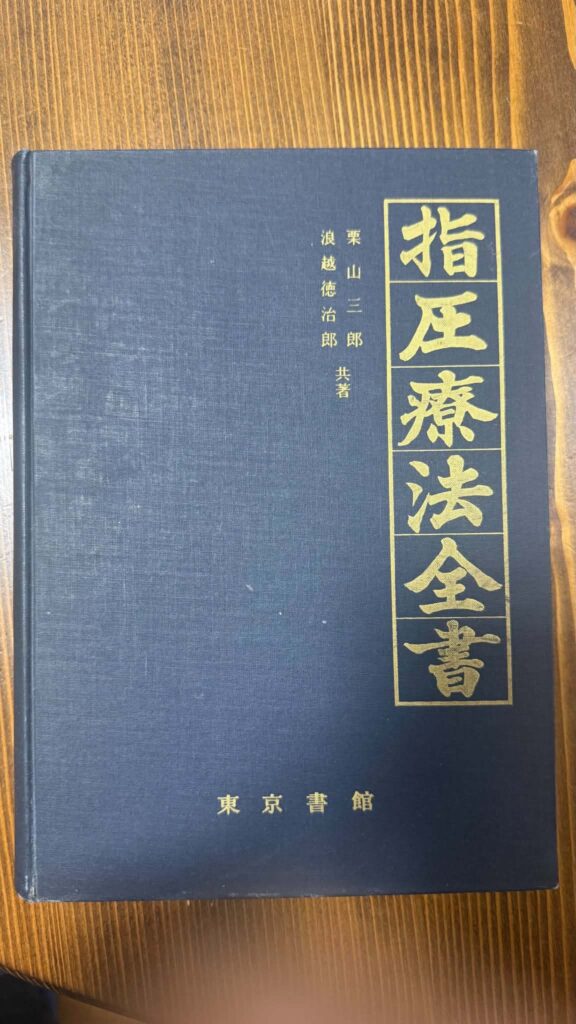
表紙(所蔵本)|株式会社日本指圧研究所Cover (copy held by the Institute) | Japan Shiatsu Institute
棚1 No.1 古書紹介 Classics of Shiatsu 指圧の古典Classics of Shiatsu
指圧療法全書
Shiatsu Ryōhō Zensho (The Complete Book of Shiatsu Therapy)
指圧の理論・実技・生理解剖・疾病治療法・食事療法の全5巻を、全一冊に収めた集大成である。
A single-volume compendium of all five volumes: theory, practice, physiology and anatomy, treatment of diseases, and dietary therapy.
1書誌情報 Bibliographic Information
- 書名Title
- 指圧療法全書Shiatsu Ryōhō Zensho (The Complete Book of Shiatsu Therapy)
- 著者Author(s)
- 浪越徳治郎・栗山三郎 共著Tokujiro Namikoshi & Saburo Kuriyama
- 出版社Publisher
- 東京書館(東京都文京区本郷5-7-6)Tokyo Shokan (5-7-6 Hongo, Bunkyo-ku, Tokyo)
- 発行年Year
- 1967年(昭和42年)1967 (Showa 42)
- 版・刷Edition
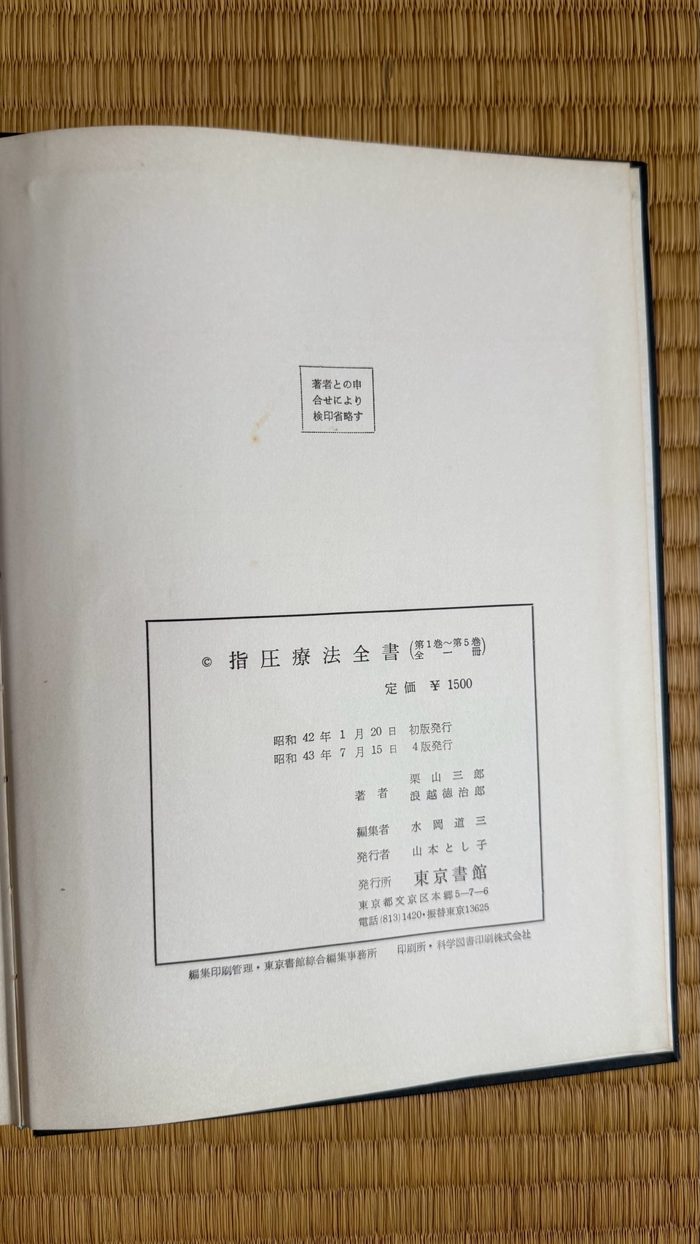
- 初版 昭和42年(1967年)1月20日/所蔵本 昭和43年(1968年)7月15日 4版発行First edition: 20 January 1967 (Showa 42) / Institute’s copy: 4th edition, 15 July 1968 (Showa 43)
- 奥付の記載Colophon
- 編集者 水岡道三
発行者 山本とし子
定価 1,500円(当時)
著者の表記は、奥付では栗山三郎・浪越徳治郎の順
※書誌は所蔵本の奥付により確定した。Volumes 1–5 in a single book (Vol. 1 Theory of Shiatsu / Vol. 2 Basic Practice / Vol. 3 Physiology and Anatomy / Vol. 4 Treatment of Diseases / Vol. 5 Dietary Therapy) - 構成Structure
- 第1巻〜第5巻を全一冊に収める(第1巻 指圧理論/第2巻 基本実技/第3巻 生理解剖編/第4巻 疾病治療法/第5巻 食事療法編)Volumes 1–5 in a single book (Vol. 1 Theory of Shiatsu / Vol. 2 Basic Practice / Vol. 3 Physiology and Anatomy / Vol. 4 Treatment of Diseases / Vol. 5 Dietary Therapy)
- 分野Subjects
- 指圧理論・基本実技・生理解剖・疾病治療法・食事療法Shiatsu theory, basic practice, physiology and anatomy, treatment of diseases, dietary therapy
- 所蔵Collection
- 株式会社日本指圧研究所Japan Shiatsu Institute Co., Ltd.
3総目次 Contents
第1巻 指圧理論
- 第1章 健康を保つには
- 第2章 指について
- 第3章 肉体と排泄
- 第4章 指圧の速効性
- 第5章 脊柱と指圧
- 第6章 指圧の作用機転
- 第7章 指圧とあん摩・マッサージの相違点
第2巻 基本実技
指圧方法及び順序/全身療法/脊柱調整法ほか
第3巻 生理解剖編
人体の構造・骨格系統・筋肉系統・神経系統・循環器系統・消化器系統・呼吸器系統・泌尿器系統・内分泌腺・感覚器系統・皮膚系統
第4巻 疾病治療法
局部治療の意義・指圧の禁忌と適応・圧痛と圧診点/消化器・骨・筋肉・神経・代謝・泌尿器・感覚器の各疾病
第5巻 食事療法編
食事のとり方/自然に従うこと/タンパク質・炭水化物・脂肪・無機質・ビタミン・水・葉緑素/付表・栗山式食事療法献立
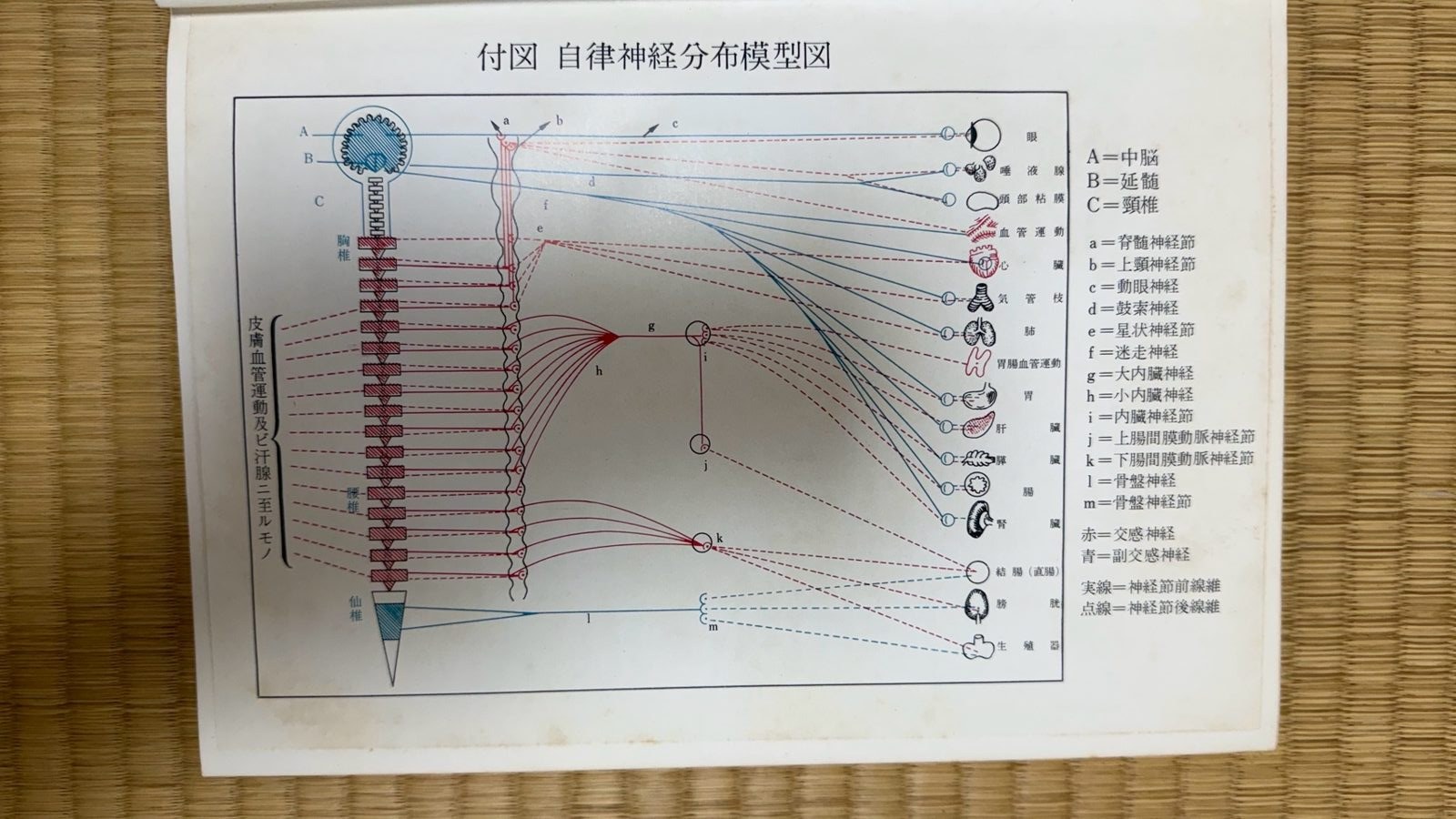
巻頭付図「自律神経分布模型図」
Volume 1: Theory of Shiatsu
- Chapter 1: How to Stay Healthy
- Chapter 2: On the Fingers
- Chapter 3: The Body and Excretion
- Chapter 4: The Immediate Effect of Shiatsu
- Chapter 5: The Spine and Shiatsu
- Chapter 6: How Shiatsu Works
- Chapter 7: How Shiatsu Differs from Anma and Massage
Volume 2: Basic Practice
Methods and sequence of shiatsu / Whole-body treatment / Spinal adjustment, etc.
Volume 3: Physiology and Anatomy
Structure of the human body; skeletal, muscular, nervous, circulatory, digestive, respiratory and urinary systems; endocrine glands; sensory organs; skin
Volume 4: Treatment of Diseases
The meaning of local treatment; contraindications and indications of shiatsu; tender points and pressure-diagnosis points / Diseases of the digestive organs, bones, muscles and nerves, metabolic diseases, and diseases of the urinary and sensory organs
Volume 5: Dietary Therapy
How to take meals / Following nature / Protein, carbohydrates, fats, minerals, vitamins, water, chlorophyll / Appendix: Kuriyama-style dietary therapy menus
Frontispiece chart: “Model Chart of the Distribution of the Autonomic Nerves”
4本の特徴 Features of the Book
- 指圧の理論・実技・生理解剖・疾病治療法・食事療法の全5巻を、全一冊に収めた集大成である。
- 創始者・浪越徳治郎と、医学博士・栗山三郎の共著。手技の体系と医学的裏付けが一冊の中で結びついている。
- 巻頭に自律神経分布模型図の付図を備え、脊柱と自律神経を軸に指圧の作用を説く構成になっている。
- 疾病治療法には現代指圧のほか、経絡指圧の応用も含まれている(凡例)。
- 「指圧とは何か」を、定義・原理・作用機転・心構えにわたって体系的に述べた、第1巻「指圧理論」が本書の核である。
- A single-volume compendium of all five volumes: theory, practice, physiology and anatomy, treatment of diseases, and dietary therapy.
- Co-authored by the founder, Tokujiro Namikoshi, and Saburo Kuriyama, a Doctor of Medicine — the system of the technique and its medical grounding are joined within one book.
- It opens with a chart of the autonomic nervous system, and explains the action of shiatsu around the axis of the spine and the autonomic nerves.
- The treatment volume includes applications of meridian (keiraku) shiatsu alongside modern shiatsu (per the book’s editorial notes).
- Volume 1, “Theory of Shiatsu,” is the core of the work: a systematic account of what shiatsu is — its definition, principles, mechanisms of action, and the attitude of the practitioner.
5要約 Summary
本の要約――「指圧とは何か」
定義
「指圧療法とは、文字通り指(ときには手掌をもって)身体の一部位に圧を加えて生体の賦活を図る手技治療である」(第2章)
「指圧とは、徒手で指母・手掌を用い体表の一定部位を押圧して生体の変調を正し、健康の維持増進をはかり、または特定の疾病治癒に寄与する施術である」(厚生省医務局医事課編定の定義を第7章が引用)
指圧の二大特徴(はしがき)
第一は「診断即治療」。指圧の押圧はすべて一押し一押しが診断であり、器具を用いず、随時随所に施すことができる。患者は押圧による快感のうちに眠ってもよいという「極楽の境地」が得られる。第二は「治療即健康」。患者が健康になれば術者も健康になるという表裏一体の関係で、指圧を施せば施すほど施術者も健康になっていく。
診断即治療とは、禅語の「啐啄同時(そったくどうじ)」と同意であると、はしがきは説く。雛が内側から殻を啐(ついば)み、親鳥が外側から啄(つつ)く、その場所も力の加減もぴたりと合うこと。患者の内から治そうとする力と、指圧師の外からの力の合一であり、術者は直接皮膚に触れ、皮膚と皮膚、生命と生命、心と心がふれ合う「治患一体」の治療である。
「『病気を治してやる』という考えを捨てること。指圧により自然癒能力(自然治癒力)が発揮されて病気が癒えていくのであって、施術者はそれを助ける役目を果たすものと考える」(はしがき・心構え)
原理
指先の触覚器官(マイスネル触小体など)は、全身の器官に先んじて発達する最も鋭敏な感覚器官であり、「手当て」は医学の始まりである。指圧の原理は圧反射にある。押圧点に通常3〜5秒間、圧を加えて数回繰り返すことで、その部位の毛管現象が盛んになり、血液循環が旺盛になって新陳代謝を促し、生体の自然癒能力を著しく助長する。また脊柱の調整を重視し、脊椎の不正が自律神経の機能不調を招くという立場から、カイロプラクティックやオステオパシーと原理を同じくすると述べている。
作用機転
直接作用は、脊柱・骨格・関節の歪みを整える矯正作用と、内臓の異常が筋の緊張・硬結として現れる内臓運動反射などに働きかける圧反射作用。間接作用は、機能の減退した筋や神経の興奮性を高め(興奮作用)、亢進したものを鎮める(鎮静作用)ことと、血液・リンパの灌流を良くする循環系への作用である。
あん摩・マッサージとの相違点(第7章)
あん摩は揉擦により体表面の緊張をほどく慰安的な行為、マッサージは筋の疲労回復を主とする行為と位置づけるのに対し、指圧は母指を主とした手掌全体で指圧点を押圧し、生体反応によって生体機能を調整(矯正)して細胞の賦活(自然癒能力の発揮)を図るものと定義する。行為は末梢より求心的に、効果は局部より全身に及ぶ、とする。
予防医学としての位置づけ(第1章・序文)
本書は指圧を、治療医学に対する予防医学の実践と位置づける。食事・運動・精神修養と指圧によって生体の自然癒能力を発揮させ、病気にかからない身体をつくること。浪越の序文は「指圧療法は、今や法的にも独立した手技療術として、また最も卓越した予防医学の実践として、専門家の間でも高く評価されております」と述べ、本書を健康を求める人々の「健康指針」と呼んでいる。
Summary — “What Is Shiatsu?”
Definition
“Shiatsu therapy is, literally, a manual treatment in which pressure is applied with the fingers (and sometimes the palm) to a part of the body in order to invigorate the living body.” (Chapter 2; translated from the Japanese)
“Shiatsu is a treatment in which the thumb and palm are applied by hand to fixed points on the body surface, pressing them so as to correct the body’s disorders, maintain and promote health, or contribute to the cure of specific diseases.” (Definition compiled by the Medical Affairs Section of the Medical Affairs Bureau, Ministry of Health and Welfare, quoted in Chapter 7)
The Two Great Features of Shiatsu (Preface)
The first is “diagnosis is treatment itself.” Every press of shiatsu is itself a diagnosis; no instruments are needed, and treatment can be given anywhere, at any time. The patient may even fall asleep in the pleasure of the pressure — a state the authors call “the realm of paradise.” The second is “treatment is health itself”: practitioner and patient are two sides of one whole, so that as the patient recovers health, the practitioner grows healthier too — the more shiatsu one gives, the healthier one becomes.
“Diagnosis is treatment itself,” the preface explains, means the same as the Zen phrase sottaku-dōji — “simultaneous pecking”: the chick pecks the shell from inside, the parent bird pecks from outside, and the place and the force meet exactly. It is the union of the power that seeks to heal from within the patient and the power applied from outside by the practitioner, who touches the skin directly — skin to skin, life to life, heart to heart — a treatment of “practitioner and patient as one.”
“Give up the idea of ‘I will cure the disease.’ It is through shiatsu that the natural healing ability (shizen-yu-nōryoku) is brought forth and the disease heals; the practitioner should regard himself as playing the part of assisting that process.” (Preface, on the practitioner’s attitude; translated from the Japanese)
Principles
The tactile organs at the fingertips (such as Meissner’s corpuscles) are the keenest sense organs, developing ahead of all other organs of the body, and “the laying on of hands” is the beginning of medicine. The principle of shiatsu lies in the pressure reflex. By applying pressure to a point for the usual three to five seconds, repeated several times, the capillary action in that region becomes vigorous, blood circulation flourishes, metabolism is promoted, and the body’s natural healing ability is greatly assisted. The book also stresses adjustment of the spine: taking the position that irregularities of the vertebrae disturb the autonomic nerves, it states that shiatsu shares its principle with chiropractic and osteopathy.
How Shiatsu Works
Its direct actions are the corrective action, which sets right distortions of the spine, skeleton and joints, and the pressure-reflex action, which acts on such reflexes as the visceromotor reflex, by which abnormalities of the internal organs appear as tension and induration of the muscles. Its indirect actions
書評|宮下雅俊 Review by Masatoshi Miyashita
本書は、浪越徳治郎先生が体系づけた「指圧とは何か」の基本が示された一冊である。指圧の定義から原理、作用機転、心構えまでが一巻に収められており、後のあらゆる指圧の実践と研究は、ここに立ち返ることになる。
一つ、論点として挙げておきたいのは、本書が「自然治癒力」ではなく「自然癒能力」という表現をあえて使っている点である。一般の辞書語は「自然治癒力(自然治癒能力)」である。しかし本書は「自然癒能力の発揮」と記す。人間本来に備わっている、自然に癒えていく能力、という意味で先生方が書かれた文字であろう。
「治」という字を外したこの表現は、「治してやろう」という治療家の思い上がった心を出させないための、文章の工夫ではなかったか。はしがきの心構え――指圧により自然癒能力が発揮されて病気が癒えていくのであって、施術者はそれを助ける役目にすぎない――と、この一文字の選択は響き合っている。治すのは指圧師ではない。癒えていくのは患者自身である。その思想が、言葉の選び方にまで貫かれているところに、本書の深さがある。
もう一つ、本書を特別な一冊にしているのは、第5巻に食事療法編が収められていることである。日本最古の医学書『医心方』(丹波康頼)は、中国の医学書を集大成した書であり、第2巻には経絡経穴図が載り、第29巻・第30巻は食養に充てられている。治療と食養が一つの体系として完成しているのが『医心方』である。本書がその構成に乗っとったかどうかは分からない。しかし、指圧の技術だけでなく、食事というものをこれほど大切なものとして一冊の中に位置づけた本は、現代の手技療法の本にはほとんどない。食事療法編を担った栗山三郎には『新食事療法全書』があり、本書の助言者であった井沢正には『医心方と指圧療法』がある。治療と食を切り離さない思想が、本書の編まれた場には流れていたのではないか。
(第一稿。宮下雅俊の口述をもとに構成)
This is the book in which the fundamentals of “what shiatsu is,” as systematised by Tokujiro Namikoshi, are set out. From the definition of shiatsu to its principles, its mechanisms of action, and the attitude of the practitioner, everything is contained within a single volume; all later practice and research in shiatsu returns to this point of origin.
One point I would like to raise is that this book deliberately uses the expression “natural healing ability” (shizen-yu-nōryoku, 自然癒能力) rather than the customary “natural healing power” (shizen-chiyu-ryoku, 自然治癒力). The standard dictionary term is the latter. But this book writes of “the bringing forth of the natural healing ability.” It is, I believe, the word the teachers chose for the ability to heal naturally that human beings possess from birth.
May this expression — which sets aside the character 治, “to cure” — not have been a device of the writing itself, meant to keep the practitioner’s arrogant thought of “I will cure them” from arising? It resonates with the attitude set out in the preface: it is through shiatsu that the natural healing ability is brought forth and the disease heals, and the practitioner merely assists. It is not the shiatsu practitioner who cures. It is the patient who heals. The depth of this book lies in the fact that this philosophy is carried through even into the choice of a single word.
One more thing makes this book special: its fifth volume is devoted to dietary therapy. Japan’s oldest medical work, the Ishinpō of Tanba no Yasuyori, a great compilation of Chinese medical texts, gives its second volume to charts of the meridians and acupuncture points, and its twenty-ninth and thirtieth volumes to dietary regimen. In the Ishinpō, treatment and diet are completed within a single system. Whether the present book consciously followed that composition, I do not know. But a book that gives diet so weighty a place alongside the technique of shiatsu is hardly to be found among modern works on manual therapy. Kuriyama, who carried the dietary volume, was himself the author of a complete book of dietary therapy; and Izawa, who advised this book, wrote The Ishinpō and Shiatsu Therapy. The conviction that treatment and food are not to be separated was, I believe, present in the place where this book was made.
(First draft, composed from the oral account of Masatoshi Miyashita. English translation by the editor.)